Game of Life
Conway's four-rule cellular automaton, rendered three ways: the classic hard-edged grid, a smoothed ambient variant, and a colorful lava-lamp take.

Came to think of this old classic and how one might visualise it today. In all its shapes it is still fascinating to look at.
About the game of life.
In 1970, the mathematician John Conway set out to find the simplest possible set of rules that could still produce unpredictable, lifelike behavior. What he landed on needs no dice, no players, and no input at all: a grid of cells, each one born, surviving, or dying based purely on how many neighbors it has. Run it forward and gliders crawl across the screen, oscillators blink in place, and whole structures spawn and collapse — all from four rules (B3/S23: a dead cell with exactly 3 live neighbors is born, a live cell with 2 or 3 neighbors survives, everything else dies).
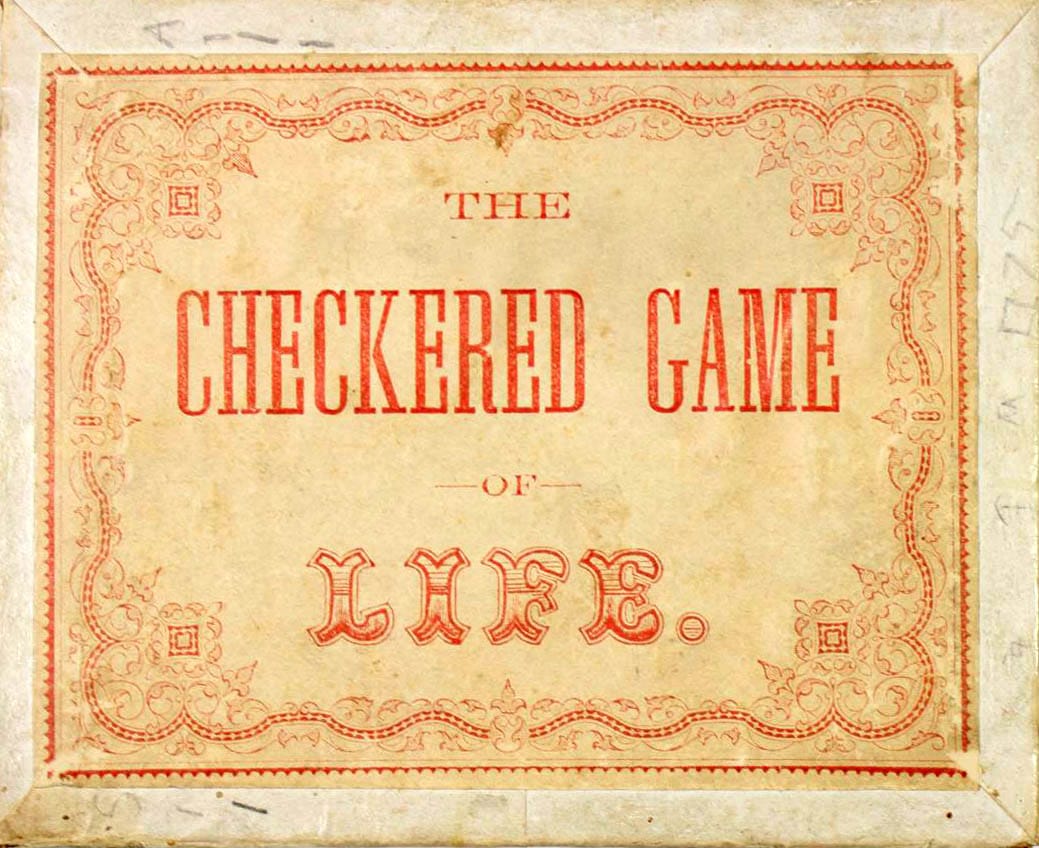
The name is a coincidence with history on its side — Milton Bradley's board game "The Checkered Game of Life" (pictured) predates Conway's automaton by over a century, and has nothing to do with cellular neighbors. Conway just liked the phrase for what his zero-player game says about life imitating rules: complexity emerging from almost nothing.
- Original — the classic pixel-grid Game of Life, running the standard B3/S23 rule on a randomized starting board. Hard edges, sharp cells, exactly as Conway would have seen it on graph paper.
- Smooth — the same rules underneath, but blended across a dual-resolution grid and softened into color gradients instead of hard pixel edges, for a more ambient, generative look.
- Lava — same simulation again, colored by local cell density instead of a rotating hue: sparse cells stay a cool, dark liquid purple, dense clusters melt into a hot magenta-to-orange wax, with a soft glow bloomed on top. No spinning camera, just a slow zoom/drift, for something closer to a lava lamp than a rainbow.